Japan
サイト内の現在位置
SC26 (International Conference for High Performance Computing, Networking, Storage, & Analysis)
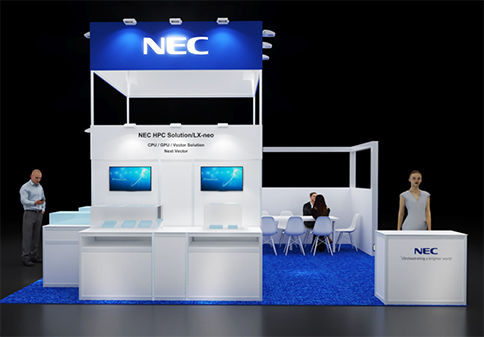
Visit NEC Booth #3423
Visit NEC Booth #3423 and learn;
- Research Data Management
- Next Vector on RISC-V
- RISC-V real sample chips
- Prototype card
- Latest NEC vector engine card
- Customer success stories
- HSM solution with partner
- Ultra-High speed data transfer solution
- Vector success stories
- CPU/GPU success stories with our partners
Research Information Infrastructure: Turning Research Data into Innovation
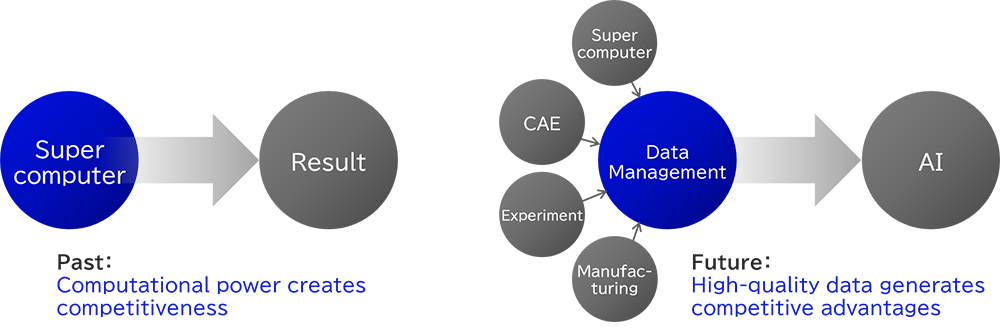
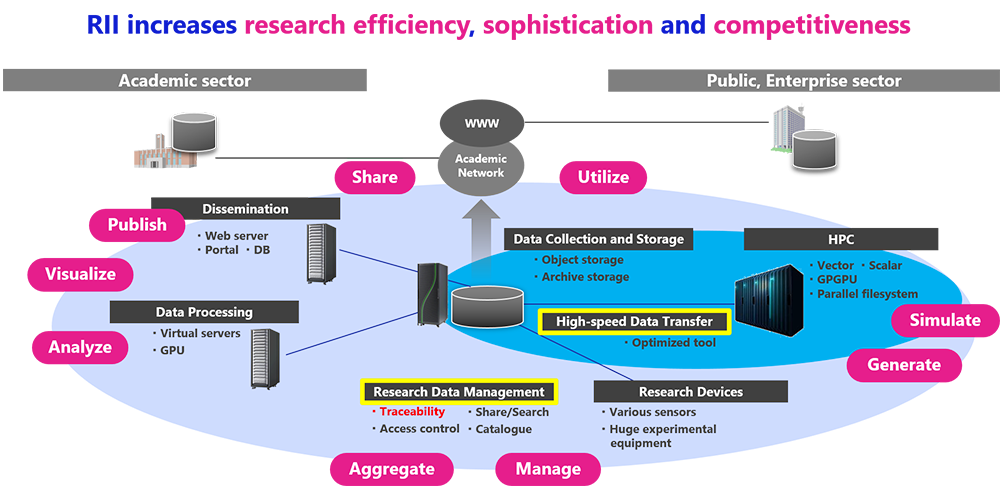
In the era of AI for Science, research competitiveness increasingly depends not only on computing performance, but also on the ability to manage and utilize high-quality data. Scientific simulations, experiments, observations, and engineering processes generate rapidly growing volumes of information. However, this data is often distributed across different systems and locations, stored in inconsistent formats, or disconnected from the context in which it was created. As a result, valuable research data can remain difficult to discover, share, verify, and reuse. NEC’s Research Information Infrastructure, or RII, is designed to address these challenges. RII provides an integrated foundation for collecting, managing, analyzing, sharing, and utilizing research data throughout the research and development lifecycle. It connects experimental and measurement equipment, high-performance computing resources, storage systems, AI environments, and researchers across organizational and geographical boundaries. By making research data more accessible, reliable, and ready for AI, RII helps organizations accelerate innovation and increase the productivity of their research activities.
At SC26, NEC will introduce key technologies supporting this vision. One is an ultra-high-speed data transfer system that enables large research datasets to be moved efficiently between laboratories, HPC systems, data centers, and cloud environments. The system is designed to utilize wide-area network bandwidth effectively by addressing end-to-end bottlenecks in servers, storage, memory, and network processing. This supports faster data sharing, multi-site data aggregation, remote collaboration, and more efficient use of distributed computing resources. Another key technology is NEC’s Data Provenance System for HPC. It automatically records relationships among programs, input data, parameters, execution processes, and output files without requiring researchers to modify existing applications or scripts. Researchers can visualize and search these relationships through a graphical interface, making it easier to reproduce computational experiments, identify the data that should be preserved, verify research results, and share knowledge with collaborators. By combining advanced computing, data management, secure data sharing, provenance tracking, and AI, NEC’s RII transforms fragmented research data into a trusted and reusable organizational asset. Visit the NEC booth at SC26 to explore how RII can help build a connected, data-driven research environment and enable the next generation of scientific and industrial innovation.
Ultra-high-speed Data Transfer System (UDTS)
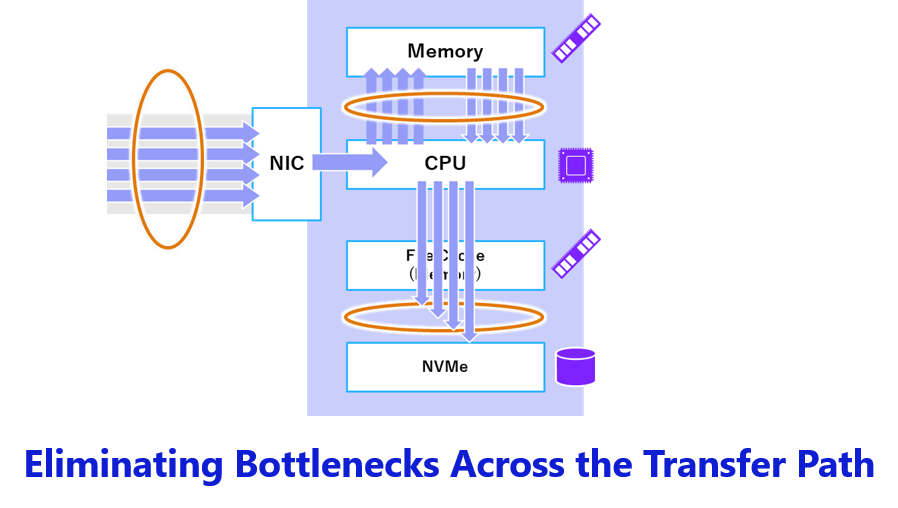
As scientific research becomes increasingly data-intensive, moving large volumes of data efficiently between research facilities, storage systems, and HPC environments is becoming a critical part of the research workflow. NEC’s Ultra-high-speed Data Transfer System (UDTS) is designed to accelerate large-scale data movement by maximizing the utilization of available network bandwidth and eliminating bottlenecks across the entire data transfer path.
UDTS combines parallel transfer technologies with optimized server-side processing to achieve high-speed end-to-end data transfer. TCP/IP socket multiplexing enables multiple data streams to use the network in parallel, while multithreading and asynchronous I/O improve processing efficiency between storage and network interfaces. UDTS supports both TCP- and UDP-based transfer modes and provides secure and reliable transfer capabilities including encryption, integrity verification, and resume functionality.
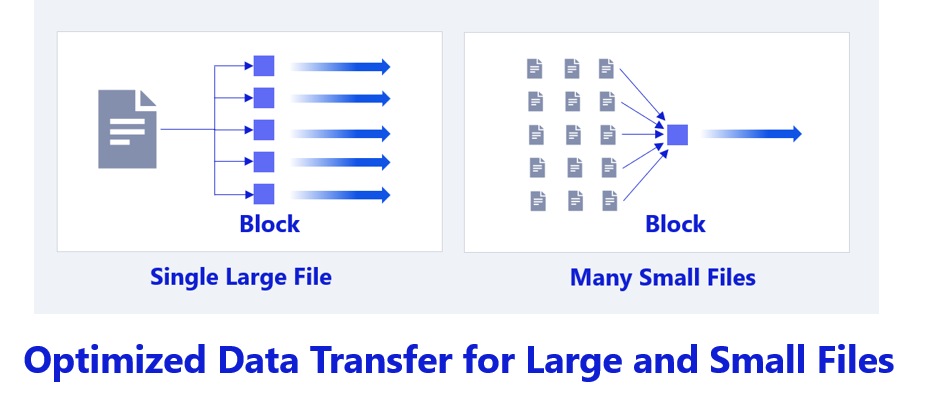
A key feature of UDTS is its ability to efficiently handle different data workloads without manual parameter tuning. Large files are divided into blocks and transferred concurrently, while many small files are packed into blocks and transferred as a stream. This enables UDTS to automatically adapt to diverse HPC, AI, and research data workloads while maintaining high throughput across the data path.
UDTS can be applied to a wide range of data-intensive research scenarios. For HPC data transfer, researchers can rapidly send large input datasets to remote HPC systems and efficiently retrieve simulation or analysis results. For observational data transfer, large volumes of data generated at remote facilities can be transferred to centralized storage and HPC environments for further processing. UDTS can also support the secure transfer of sensitive data, such as medical imaging data. Workflow and scheduler integration further enables automated data movement within research workflows.
At SC24, NEC demonstrated the transfer of a 1 TB single file in just 1.5 minutes over a 100 Gbps link between Atlanta and Tokyo, demonstrating UDTS in a long-distance, high-bandwidth environment. NEC provides UDTS as a high-performance data transfer solution combining hardware, software, system integration, and performance tuning to help organizations accelerate data-intensive research and make more effective use of their network and computing infrastructure.
Data Provenance System for HPC (DPS4H)
Making HPC Research Reproducible, Traceable, and Reusable
As scientific computing workflows become increasingly complex, understanding how research results were produced is essential for reproducibility and effective data reuse. NEC’s Data Provenance System for HPC (DPS4H) automatically captures and manages computational provenance in HPC environments, helping researchers trace the complete path from input data through computational processes to final results.
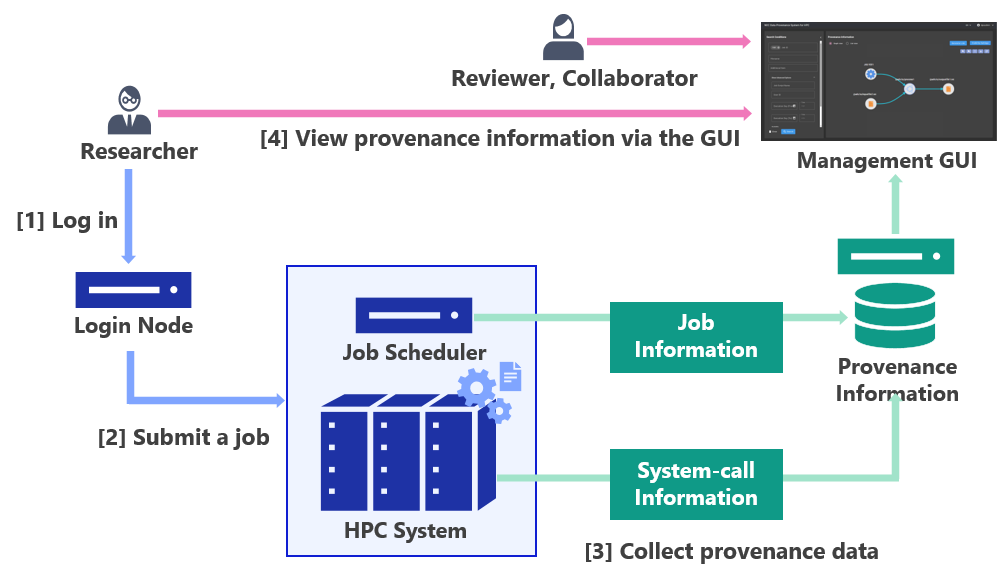
DPS4H is designed to capture provenance without requiring researchers to modify their applications, scripts, or existing workflows. Researchers simply submit and run their HPC jobs as usual. DPS4H collects job information from HPC schedulers and system-level information related to file access and program execution, then stores these relationships as provenance information. This approach links input data, computational processes, and output data while minimizing the performance impact on HPC workloads.
An intuitive management interface makes this provenance information easy to explore. Researchers can search for entities such as files, job IDs, and processes, and visualize the complete computational data flow, including relationships between input files, execution processes, and output files. This allows researchers to understand how a particular result was generated and identify the data, software, and parameters required to reproduce it. DPS4H can also help identify which research assets need to be preserved for future reproducibility, reducing the need to retain unnecessary files.
Beyond reproducibility, provenance can become a valuable source of research knowledge. NEC is exploring an AI-based automated knowledge documentation concept that uses provenance captured by DPS4H to generate narratives describing how researchers arrived at their results. For example, the provenance from a series of simulation experiments can capture changes in parameters and their resulting outputs. AI can then transform this history into a narrative that makes the research process easier to understand and share. This concept is currently under development.
By turning computational history into structured, searchable, and reusable information, DPS4H supports reproducibility, knowledge sharing, and reuse of HPC research.
Demonstration of a UDTS-Integrated SRCNet Data Control System
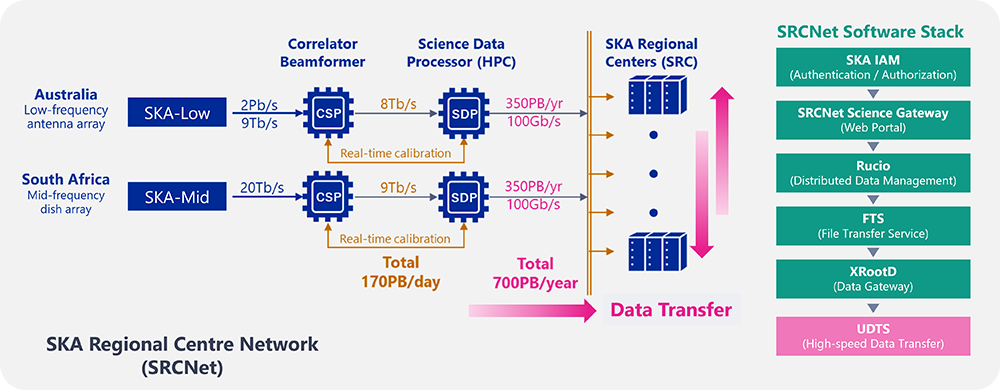
The SKA Observatory (SKAO) is an international organization responsible for constructing and operating the Square Kilometre Array (SKA), one of the world's largest radio astronomy projects. The telescopes currently under construction in Australia and South Africa are expected to generate enormous volumes of observational data, reaching hundreds of petabytes annually. To process, distribute, and analyze these datasets, the SKA Regional Centre Network (SRCNet) is being established as a globally distributed research infrastructure connecting SKA Regional Centres (SRCs) around the world.
Efficient and reliable data transfer across international research networks is essential for SRCNet. Transferring massive scientific datasets over long-distance, high-bandwidth networks presents significant technical challenges, particularly in achieving high throughput while maintaining interoperability with existing data management systems.
To address these challenges, NEC is collaborating with the National Astronomical Observatory of Japan (NAOJ) and other research organizations to evaluate the integration of NEC's Ultra-high-speed Data Transfer System (UDTS) into the SRCNet data transfer workflow. UDTS is designed to achieve high-speed, stable data transfers over wide-area networks. By integrating UDTS with the existing SRCNet software stack, including SKA IAM, Rucio, FTS, and XRootD, the project aims to accelerate inter-site data transfers while preserving existing data management and transfer control workflows.
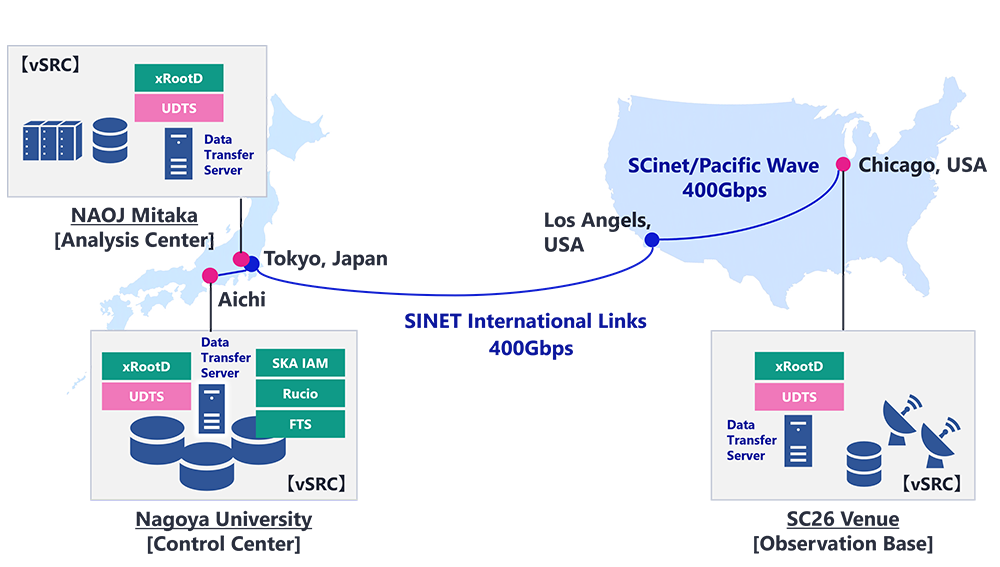
At SC26, NEC and its research partners will present a live demonstration of this UDTS-integrated data control system as part of the Network Research Exhibition (NRE) at the National Institute of Informatics (NII) booth. The demonstration will connect three geographically distributed sites as virtual SRCs: NAOJ Mitaka, Nagoya University, and the SC26 exhibition venue, using Virtual Private LAN Service (VPLS) over high-speed international research networks. It will showcase coordinated data transfers using the SRCNet software stack integrated with UDTS, including real-time visualization of transfer operations and performance.
Please also visit the NII booth (#1459) to see the live demonstration and  NII web site.
Next Vector Project: Advancing HPC and AI on the RISC-V Architecture
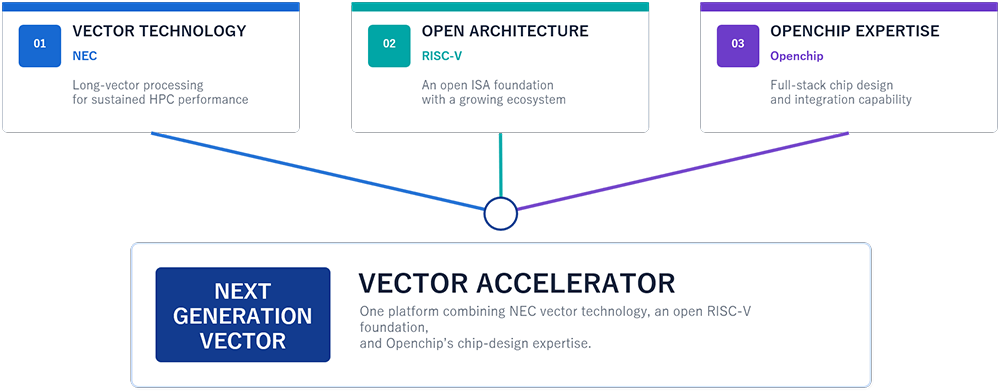
A vector accelerator is a computing device designed to perform the same operation on many pieces of data at once. This approach is especially effective in high-performance computing, or HPC, where applications must process vast amounts of numerical data quickly and efficiently. For decades, NEC vector technology has supported demanding workloads such as weather forecasting, climate research, scientific simulation, and engineering analysis.
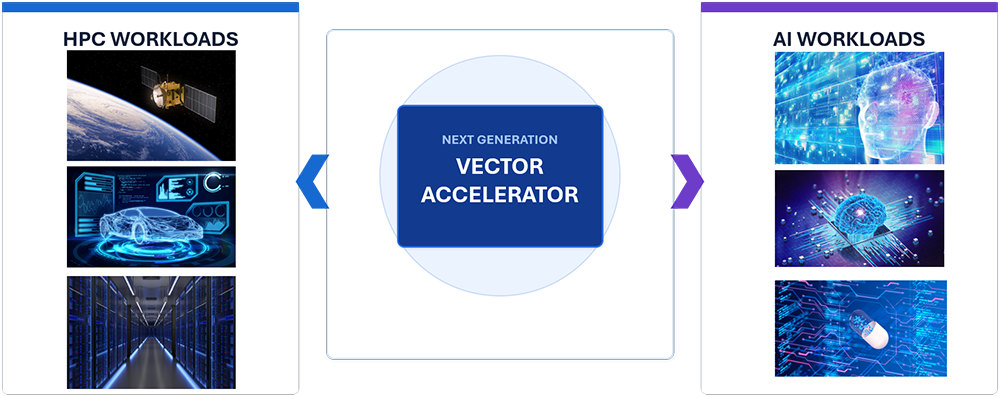
NEC is now developing a Next Generation Vector Accelerator with Openchip & Software Technologies (Openchip). The project builds on the strengths of vector computing for HPC while extending those strengths to artificial intelligence and machine learning. The planned accelerator combines a long vector unit for scientific workloads with a matrix extension for AI. Vector processing can efficiently handle long sequences of scientific data, while matrix operations are widely used in AI training and inference. By bringing these capabilities together, the accelerator is intended to support both established simulation workloads and emerging AI applications.
The accelerator will use RISC-V, an open and royalty-free instruction set architecture. Because RISC-V specifications are open, companies and research organizations can collaborate, introduce new technologies, and expand the platform over time. RISC-V also offers a growing hardware and software ecosystem, together with a standard vector extension. These characteristics make it well suited to the open and flexible computing platform we aim to create.
The project also places strong emphasis on usability for existing NEC vector users. NEC plans to carry forward technologies developed for the SX Series, including the compiler frontend, optimizer, vectorizer, numerical libraries, and performance-analysis tools. This approach is expected to allow many existing applications to run after recompilation, without extensive code rewriting, helping users protect their software investments and move more smoothly to the new platform.
By combining proven vector technology, AI-oriented matrix processing, and the openness of RISC-V, NEC and Openchip aim to create an easy-to-use and power-efficient accelerator for future HPC and AI workloads.
At SC26, visitors will be able to see a mock-up of the Next Generation Vector Accelerator at the NEC booth. The exhibit will provide a closer look at the project’s direction and its vision for bringing HPC and AI together. Visit the NEC booth to explore the concept, learn about the technology, and speak with the team about the future of vector computing.